This section of the Foss is where there is no section of city wall. The River Foss formed a large swampy area around here which was eventually cut into a drainage channel and the swampy area that is now Hungate was drained. Hungate is undergoing redevelopment and has been thoroughly dug over by the archaeologists who have turned up finds from Roman times through Viking up to the early 19th century. The first stage of the redevlopment is nearing completion and the buildings along Foss View are starting to be occupied.
Showing posts with label Romans. Show all posts
Monday, 28 September 2009
Follow The Foss - 4 - Foss view to Foss Islands Bridge
Just out of the covered walkway gives a closer glimpse of the moored rubbish collection boat and the chimney from the former power station that used to generate electricity for the city now standing next to Morrisons. The power station building that housed the generators stood where Halfords and Staples now stands.
Continuing upstream on the left behind the trees you can just about see the edge of the DEFRA site (or whatever they are calling themselves these days, they used to be MAFF) which stands on the former site of engineering firm Adam's Hydraulics. Straight ahead you can see one of the bridge structures of the Foss Islands junction. This junction used to be a learner's nightmare with two hump backed bridges and multiple junctions to negotiate.
Behind the bridge you can see the point where the city walls break at Layerthorpe Postern and the marshlands of Foss Islands provided the defence line for the city. On foot you now need to follow a complicated route to get yourself onto Fossbank, see map below. Turn left onto the bridge in the above picture cross towards Layerthorpe Postern but at the island in between turn right to take you past the lighting arrangement in the following picture and then left where you will be against the flow of motor traffic onto Fossbank.
Posted by
JollyGreenP
at
08:33
0
comments
Labels: Chimney, DEFRA, Foss Islands bridge, Foss View, Fossbank, Hungate, MAFF, Morrisons, Romans, Rubbish Collecting Boat, Vikings, York Power Station
Monday, 1 December 2008
Ouse Bridge
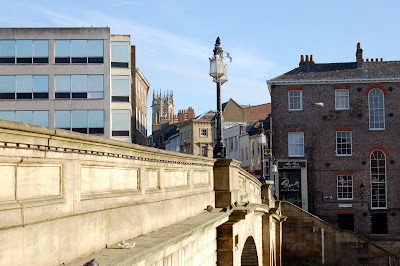
The first bridge in York was built by the Romans and linked with Stonegate. This was replaced by the Vikings who built a wooden bridge where the present day Ouse Bridge is sited. In 1154 a large crowd gathered on the bridge for the return from exile of St William of York. It was more than the structure could bear and it collapsed into the river. A stone replacement was built but was partially swept away by flooding in the winter of 1564/5. The repaired bridge had a magnificent central arch spanning 81 feet and was described by Defoe as the greatest in England. In 1810 work was stared to dismantle this bridge and replace it with the New Ouse Bridge designed by Peter Atkinson the Younger and was completed in 1821.
Notice the handy shelf which idiots use to stand on during hot summer days before launching themslves off the bridge into the water below if they are lucky or into the bows of a pleasure boat and breaking bones or killing themselves if they are not so lucky.
In the distance you can see the lantern tower of All Saints Pavement Church.
Notice the handy shelf which idiots use to stand on during hot summer days before launching themslves off the bridge into the water below if they are lucky or into the bows of a pleasure boat and breaking bones or killing themselves if they are not so lucky.
In the distance you can see the lantern tower of All Saints Pavement Church.
Posted by
JollyGreenP
at
08:45
0
comments
Labels: Ouse Bridge, Ouse Bridge Inn, Romans, St William of York, Vikings
Subscribe to:
Posts (Atom)